
Last updated July 15, 2026
The Complete Guide to Air Duct Cleaning in Rochester
After inspecting ducts in hundreds of Rochester homes, the single most common finding isn’t dust — it’s moisture-driven debris from a heating system that runs 7 months a year in a high-humidity Great Lakes climate. Lake-effect moisture doesn’t stay outside; it infiltrates ductwork, condenses in cold return plenums, and creates a sticky, microbial-friendly environment that dry-climate duct cleaning guides never mention. In this guide, we’ll walk through what Rochester homeowners actually need to know: how our specific climate patterns contaminate ducts, why older housing stock in neighborhoods like Park Avenue and Corn Hill demands different cleaning approaches than new builds in Pittsford or Henrietta, and how to tell a legitimate inspection from a bait-and-switch sales pitch.
Quick Answer
Our Air Duct Cleaning services in Rochester typically cost $350–$650 for a standard single-family home and include full-system agitation, negative-pressure extraction, and a pre-cleaning video inspection. Because of Rochester’s lake-effect humidity and extended heating season, most homes here benefit from cleaning every 3–5 years — sooner if you notice musty odors, visible mold, or airflow that’s dropped noticeably from room to room.
Table of Contents
- Why Rochester’s Climate Changes Everything About Duct Cleaning
- What a Legitimate Duct Cleaning Actually Looks Like
- Older Rochester Homes vs. Newer Builds: Different Beasts
- The NADCA Standard: How to Verify It, Not Just Hear It
- DIY Checks You Can Do Between Professional Cleanings
- What Air Duct Cleaning Costs in Rochester
- Common Mistakes to Avoid
- When to Call a Professional
- Frequently Asked Questions
Why Rochester’s Climate Changes Everything About Duct Cleaning
Rochester sits in a unique meteorological zone. Lake Ontario moderates temperatures but pumps moisture into the air year-round, especially during fall and winter when cold air masses sweep across relatively warm water. That moisture becomes your ductwork’s biggest enemy.
Here’s what happens inside Rochester homes specifically:
- Extended heating season: From October through April, furnaces run constantly. Warm supply air hits cold duct walls in unconditioned spaces — attics, crawl spaces, exterior wall chases — and condensation forms. In the Park Avenue historic district, we’ve pulled insulation fragments saturated with moisture from 1920s duct runs that were never designed for forced air.
- Summer humidity spikes: July and August bring dew points above 65°F. Air conditioning cools duct surfaces below that dew point, and water beads on interior surfaces. In Greece and Irondequoit homes near the lake, we’ve documented return plenums with active water staining during peak summer weeks.
- Seasonal temperature swings: Rochester’s 30–40°F daily swings in spring and fall cause ducts to “breathe,” drawing attic and crawl space air through seams. That air carries pollen, fiberglass particles, and in older neighborhoods, legacy construction debris.
The result? Rochester duct contamination isn’t primarily dry, flaky dust. It’s a layered cake of: dust mites and their fecal pellets (thriving in 50%+ humidity), skin cells bound with moisture, pollen that swells and sticks, and microbial growth on organic films. A standard vacuum pass — the kind some low-price operators perform in 45 minutes — doesn’t remove this adhered material. It requires mechanical agitation to break the bond, then negative-pressure extraction to pull it out without redistributing through the home.
In Brighton and Penfield subdivisions built in the 1960s–1980s, we regularly find flex duct that’s collapsed internally from moisture degradation. The homeowner reports “weak airflow upstairs,” and the culprit isn’t a dirty duct — it’s a duct that’s been wet, moldy, and partially collapsed for years. Cleaning alone won’t fix that; it requires repair or replacement. This is why Matthew shows up on every job personally: to distinguish between a cleaning candidate and a repair situation that a phone-quote operation would miss entirely.
What a Legitimate Duct Cleaning Actually Looks Like
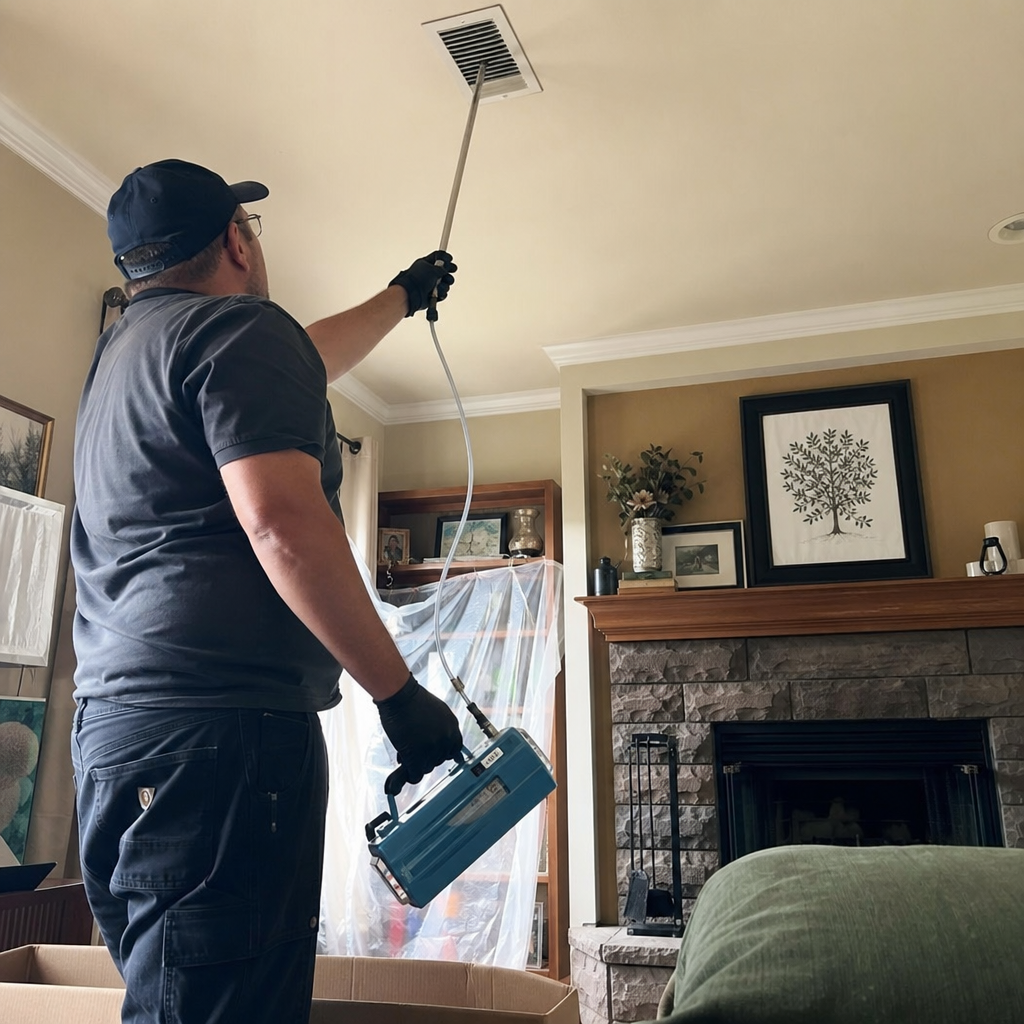
Before any cleaning begins, there should be an inspection — not a sales pitch disguised as one. Here’s what happens when Matthew arrives at a Rochester home with our professional-grade Rotobrush and Nikro systems:
- Visual assessment of the full system: We examine the furnace or air handler, the evaporator coil if accessible, the blower assembly, and representative supply and return runs. In Rochester’s older homes, we’re specifically looking for asbestos-containing duct tape or insulation (common pre-1980), disconnected flex runs, and signs of water intrusion.
- Video scope inspection: We feed a camera into trunk lines and key branches, recording what we find. You see it in real time. If a contractor won’t show you — or claims they “don’t need to” because they can tell from the vents — that’s a red flag.
- System sealing and protection: Return grills get sealed. The furnace blower compartment is protected. We create negative pressure at the collection point so dislodged debris goes into our Nikro HEPA-filtered collection system, not your living room.
- Mechanical agitation: This is where professional equipment separates legitimate operators from shop-vac pretenders. Our Rotobrush system uses rotating brushes sized to duct diameter, contacting all surfaces. For rigid metal ductwork common in pre-1970 Rochester homes, we may use pneumatic whips or skipper balls that navigate elbows and offsets.
- Negative-pressure extraction: Simultaneous with agitation, our Nikro system pulls 2,000+ CFM of vacuum at the collection point. This isn’t a vacuum cleaner; it’s a dedicated duct cleaning machine with HEPA filtration rated to 99.97% at 0.3 microns.
- Post-cleaning verification: We re-scope representative runs and show you the difference. We also check static pressure before and after to confirm airflow improvement.
- Sanitizing (when indicated): For Rochester homes with moisture-driven microbial growth, we apply EPA-registered sanitizers through the system. This isn’t a substitute for cleaning — it’s a finishing step after mechanical removal.
The entire process for a typical 2,000-square-foot Rochester home takes 3–5 hours. Anyone in and out in 90 minutes is not performing this protocol. We’ve been called to Air Duct Cleaning in Rochester homes where a previous “cleaning” left the registers dirtier than when they started — because the operator used a compressed air nozzle without containment, blasting debris into occupied spaces.
Older Rochester Homes vs. Newer Builds: Different Beasts
Rochester’s housing stock spans 150 years, and duct cleaning strategy must adapt. Here’s how we approach the three main categories:
Pre-1940: Gravity and Octopus Systems
In neighborhoods like Corn Hill, the South Wedge, and parts of Maplewood, original heating was gravity-fed coal or oil — the “octopus” furnace with large, uninsulated ducts. Many have been retrofitted with forced-air furnaces, but the ductwork remains oversized, unsealed, and often lined with decades of accumulated debris.
Challenges we encounter:
- Asbestos-containing insulation or tape (we coordinate with certified abatement contractors when found)
- Disconnected or partially collapsed sections from vibration of newer blowers
- Return pathways through wall cavities rather than dedicated ductwork, making negative-pressure cleaning impossible without creative containment
- Lead paint on original registers and grilles
These homes require patience and adaptation. We can’t always achieve full-system negative pressure, so we work in zones with portable HEPA containment. Matthew’s 17 years of focused experience — not generalist handyman work — matters here.
1940–1990: Mid-Century and Ranch-Era Systems
Suburban expansion brought smaller ductwork, often galvanized steel with fiberglass lining. In Henrietta, Greece, and early Pittsford developments, we see:
- Deteriorated fiberglass lining that sheds particles into airflow
- Original duct tape failing at seams, creating leakage and drawing in attic/crawl space air
- Systems sized for heating only, struggling with added cooling loads
These systems often benefit from Elite Air Duct Cleaning Service Greater Rochester home services beyond cleaning — specifically duct sealing to address the leakage that’s been pulling contaminants for decades.
1990–Present: Tighter Construction, New Problems
Newer homes in Webster, Fairport, and Victor feature flex duct, tighter envelopes, and often whole-house humidifiers. The trade-off: less infiltration, but any moisture problem concentrates. We find:
- Flex duct crushed by storage in attics or sagging over time
- Humidifier overuse creating wet evaporator pads and downstream moisture
- Very fine filtration (MERV 13+) on undersized returns, straining blowers and causing filter bypass
Cleaning these systems requires gentler agitation to avoid damaging flex duct, and we often recommend upgrading to rigid duct or adding support where sagging occurs.
The NADCA Standard: How to Verify It, Not Just Hear It
The National Air Duct Cleaners Association (NADCA) publishes ACR, the Assessment, Cleaning, and Restoration standard. Every legitimate contractor mentions it. Few actually follow it. Here’s how to verify:
- Ask for their NADCA membership number. Verify it at nadca.com. Membership requires adherence to ACR standards and carries insurance requirements.
- Request the pre-inspection checklist. NADCA ACR specifies what must be evaluated: system type, accessibility, contamination level, and any conditions that would preclude cleaning. A legitimate contractor documents this before quoting.
- Demand containment documentation. The standard requires HEPA-filtered collection, negative pressure during agitation, and protection of occupied spaces. Ask how they achieve this — specific equipment names, not “our powerful vacuums.”
- Check for post-cleaning verification. NADCA requires some form of verification that cleaning was effective. We use video re-inspection and static pressure measurement. Others may use particle counters. “Trust me, it’s clean” is not compliant.
- Review their scope of work. ACR defines what components must be addressed: supply and return ductwork, registers/grilles, diffusers, heat exchangers, cooling coils, drain pans, fans, and air handling unit housing. A quote for “duct cleaning” that doesn’t mention the air handler is incomplete.
In Rochester’s market, we’ve encountered operators who claim “NADCA-certified” when only the company owner took a one-day seminar, or who use the logo without current membership. The verification steps above protect you.
Our approach: we follow ACR because it’s the right technical standard for the work, not because it’s a marketing checkbox. Matthew’s been cleaning ducts since before NADCA’s current certification structure existed; the standards codify what experience taught us were necessary practices.
DIY Checks You Can Do Between Professional Cleanings
Professional cleaning every 3–5 years doesn’t mean ignoring your system in between. For Seasonal Air Duct Cleaning Care for Rochester: Year-Round Homeowner’s Guide, here are specific checks you can perform tuned to our climate:
Monthly Visual Checks
- Register condition: Remove a supply register and look inside with a flashlight. Dust accumulation on the duct walls beyond arm’s reach indicates it’s time for professional attention. A light coating near the opening is normal; thick, fuzzy buildup or dark staining is not.
- Return grille filter fit: A filter that bows inward or has gaps around the edges is bypassing unfiltered air. In Rochester’s pollen-heavy spring, this accelerates duct contamination. Replace with a properly sized filter — never force an incorrect size.
- Condensate drain line: During cooling season, verify the AC drain is flowing. A clogged drain backs water into the system, and in our humid climate, that means mold within days. The drain outlet near your foundation should drip when the AC runs.
Seasonal Performance Checks
- Room-to-room airflow balance: Close all doors. Feel airflow at each supply register with your hand. A register that was strong last season and is now weak suggests blockage — collapsed flex, debris accumulation, or damper closure. In Rochester’s older homes, we see this frequently in second-floor rooms where original duct sizing was marginal.
- Odor assessment when heat first cycles: A brief dusty smell in October is normal (dust burning off heat exchanger). A musty or moldy smell that persists suggests moisture in ductwork — common after humid summers in lake-effect zones. Don’t mask it with air fresheners; investigate the source.
- Humidifier inspection: If you have a whole-house humidifier, check the pad or drum in fall. Mineral-encrusted or moldy media blows contaminants directly into ducts. In Rochester’s hard water areas (much of Monroe County), scale buildup is aggressive.
Annual Professional-Grade Check
Once a year, during your HVAC maintenance visit, ask the technician to photograph the blower wheel and evaporator coil. These components are upstream of ductwork; if they’re contaminated, your ducts will follow. We offer HVAC Cleaning in Rochester as a distinct service because coil and blower cleaning requires different techniques than duct cleaning — but the contamination is connected.
What Air Duct Cleaning Costs in Rochester
Pricing varies with system size, accessibility, and contamination level. Below are 2024–2025 ranges we see in the Rochester market for legitimate, equipment-based cleaning — not blow-and-go operations:
| Service Component | Typical Range | Notes |
|---|---|---|
| Standard residential duct cleaning (single system, up to 2,500 sq ft) | $350–$650 | Includes supply and return ductwork, registers, basic air handler cleaning |
| Larger home or zoned system (2,500–4,000 sq ft) | $650–$950 | Additional trunk lines, more access points, longer labor |
| Dryer vent cleaning (standalone) | $150–$250 | Required by fire code; we bundle with duct cleaning at reduced rate |
| HVAC component cleaning (coil, blower, detailed air handler) | $200–$400 | Often reveals need for Dryer Vent Cleaning in Rochester or repair work |
| Duct repair & sealing (per project) | $300–$1,500+ | Highly variable; requires inspection to quote accurately |
| Air quality sanitizing | $75–$150 | Applied post-cleaning; not a substitute for mechanical removal |
Red flags in Rochester pricing:
- Sub-$200 “whole house” specials: These are loss-leader bait. The operator arrives, declares your system “too contaminated for the special,” and upsells dramatically — or performs a 45-minute vacuum job that leaves most debris in place.
- Per-vent pricing without inspection: A legitimate quote requires knowing duct configuration, not just counting registers.
- Phone quotes without questions: If they don’t ask about system type, age, accessibility, and recent issues, they’re not pricing accurately — they’re pricing to get in the door.
We provide firm, written estimates after inspection — not before. The inspection itself is free, and you’ll know exactly what you’re paying for before any work begins.
Common Mistakes to Avoid
- Booking based on coupon price alone. In Rochester’s market, we’ve cleaned up after $99 specials that left homeowners with contaminated blowers and scratched ductwork. The money “saved” was spent twice over on proper remediation.
- Ignoring the air handler. Cleaning ducts without addressing the blower, coil, and drain pan is like mopping your floor while your boots are still muddy. The contamination source remains active.
- Assuming new homes don’t need cleaning. Construction debris in new Rochester builds — especially drywall dust and fiberglass — is often severe. We recommend cleaning before occupancy, not waiting years.
- Using the wrong filter. High-MERV filters on undersized returns strain systems and cause filter bypass. In Rochester’s older homes with original duct sizing, MERV 8–11 is often the practical maximum without system modification.
- Neglecting dryer vents while focusing on ducts. Dryer lint accumulation is a leading fire cause nationally and locally. Dryer Vent Cleaning in Rochester should be annual, not an afterthought.
- Accepting “mold” claims without proof. Some operators use scare tactics with instant “mold tests” (often just peroxide on dust). Legitimate mold concerns require laboratory analysis and remediation protocols, not just cleaning.
- Waiting for visible dust at registers. By the time you see it, the system is heavily loaded. Proactive maintenance based on interval and risk factors (pets, renovations, humidity issues) prevents the problems that become visible.
When to Call a Professional
Call for an inspection — not necessarily cleaning — when you notice: persistent musty odors when the system runs; visible mold or moisture in registers or duct openings; airflow that’s dropped significantly from room to room; recent renovation work (dust bypasses even good filtration); or it’s been 5+ years since any professional attention, especially in lake-humidity zones like Rochester.
More urgent: if you smell burning, hear unusual blower noise, or see water actively leaking from ductwork. These indicate system problems beyond contamination.
Elite Air Duct Cleaning Service Greater Rochester offers free estimates in Rochester — call (844) 593-2704. Matthew Gonzalez personally evaluates every job, and if cleaning isn’t the right solution, we’ll tell you what is. From cleaning to sealing to sanitizing, we address the full indoor air scope, not just a vacuuming pass.
Frequently Asked Questions
Professional air duct cleaning in Rochester typically runs $350–$650 for a standard single-family home, with larger or more complex systems ranging up to $950. The exact price depends on your home’s square footage, duct accessibility, and whether additional services like HVAC component cleaning or sanitizing are needed. Call (844) 593-2704 for a free, no-obligation estimate after inspection — we don’t quote blind over the phone.
Every 3–5 years for most Rochester homes, but sooner if you have pets, recent renovations, or moisture issues. Our lake-effect humidity and 7-month heating season accelerate contamination compared to drier climates. Homes near Lake Ontario in Greece or Irondequoit may need more frequent attention due to higher ambient moisture. We assess interval recommendations during our inspection based on your specific system and conditions.
It can reduce allergen reservoirs in ductwork — dust mites, pollen, pet dander — but it’s not a standalone allergy solution. The greatest benefit comes when cleaning is paired with source control (proper filtration, humidity management between 30–50%, and addressing moisture intrusion). In Rochester’s high-pollen spring and humid summer, clean ducts remove accumulated reservoirs that would otherwise recirculate continuously.
Yes. Duct cleaning addresses the distribution network — supply and return ducts, registers, and grilles. HVAC cleaning targets the air handling unit itself: blower wheel, evaporator coil, heat exchanger, and drain pan. Contamination in either location affects the other. We offer both as distinct services because they require different equipment and techniques, though we often perform them together for complete system restoration.
For How to Hire a Air Duct Cleaning Contractor in Rochester: A Step-by-Step Guide, verify NADCA membership at nadca.com, ask specific equipment questions (they should name brands like Rotobrush or Nikro, not vague “professional equipment”), demand pre- and post-cleaning video inspection, and refuse phone quotes without inspection. In Rochester’s market, we’ve seen operators with rented carpet cleaning machines and shop vacs posing as duct specialists. Matthew shows up on every job with our dedicated systems — no subcontractors, no rented gear.
Properly performed cleaning won’t damage sound ductwork. However, pre-existing deterioration — common in Rochester’s aging housing stock — may be revealed during cleaning. We’ve encountered disconnected flex duct, corroded metal, and asbestos-containing materials that required repair or abatement before cleaning could proceed safely. This is why inspection comes first, and why experience with older systems matters. Our 17 years in this trade means we’ve seen the conditions common to Rochester’s neighborhoods and know how to adapt.
The Bottom Line
Rochester’s climate and housing stock create duct contamination patterns that generic advice misses. Lake-effect moisture, extended heating seasons, and century-old construction demand a locally informed approach — not a franchise playbook. The right cleaning protocol includes thorough inspection, mechanical agitation with professional-grade equipment, negative-pressure containment, and verification afterward. The wrong approach wastes money and can damage your system. Whether you’re in a Park Avenue Victorian or a new Pittsford build, the fundamentals remain: inspect first, clean with purpose, and verify the result. For more guides & resources, explore our site. Your ductwork will tell you what it needs — if someone takes the time to listen.
Written by Matthew Gonzalez, Owner & Lead Technician at Elite Air Duct Cleaning Service Greater Rochester, serving Rochester since 2009.