
Last updated July 15, 2026
Seasonal Air Duct Cleaning Care for Rochester: Year-Round Homeowner’s Guide
Rochester homeowners run their heating systems harder and longer than most of the country — then flip to cooling in a compressed spring window. That seasonal whiplash is exactly when duct problems that built up all winter announce themselves. Most guides treat duct cleaning as a one-and-done annual chore, but our Air Duct Cleaning Maintenance Checklist for Rochester Homeowners shows how four genuinely distinct seasons each create different contamination triggers, airflow demands, and system stresses. In this guide, you’ll learn how to time inspections, what to watch for as seasons change, and how to build a maintenance cycle around Rochester’s actual climate instead of a generic 3–5 year industry average.
Quick Answer
Rochester homeowners should inspect ducts each season and schedule Air Duct Cleaning services every 18–24 months — with the critical window being late spring, after the heating season ends but before summer humidity rises. Fall furnace startup odors, winter’s extended debris accumulation, spring’s post-heating inspection opportunity, and summer’s humidity-driven condensate risks each demand different attention.
Table of Contents
- Fall Furnace Startup: What Those First-Heat Odors Really Mean
- Winter Heating Season: How Rochester’s Extended Cold Accelerates Buildup
- Spring Inspection Window: The Most Strategic Time for Professional Cleaning
- Summer AC Mode: Humidity, Condensate, and Duct Risks
- Building Your Two-Year Rochester Cleaning Cycle
- What Homeowners Can Check vs. What Requires Professional Equipment
- Common Mistakes to Avoid
- When to Call a Professional
- Frequently Asked Questions
Fall Furnace Startup: What Those First-Heat Odors Really Mean
October in Rochester means that first furnace firing — and almost always, a brief burnt-dust smell. Most homeowners dismiss it. Sometimes that’s fine. Sometimes it’s an early warning.
That odor comes from dust settling on heat exchangers and in supply ducts during the idle months. In a clean system, it dissipates in minutes. If it lingers beyond a day, or returns throughout the season, you’re likely smelling accumulated debris being reheated repeatedly — pet dander, cooking oils that migrated through return vents, pollen from Rochester’s heavy ragweed season, even rodent activity from summer’s nesting period.
Here’s what we check when Matthew shows up on fall calls in neighborhoods like Park Avenue and Corn Hill:
- Return grille dust loading: Heavy buildup at returns signals the trunk line is saturated.
- Blower compartment debris: The blower wheel is the system’s lungs — when caked, airflow drops and the furnace works harder.
- Heat exchanger inspection access: While we’re in the system, we verify no blockages that could cause rollout or CO risk.
- Filter fit and bypass gaps: A 1-inch filter rattling in a 2-inch slot is filtering nothing.
Rochester’s fall also brings specific challenges: leaf mold spores peak in October, and homes with mature oak or maple canopies — common in the 19th Ward and Highland Park areas — see higher organic debris intake through outdoor air intakes. If your system has a fresh air intake, fall is when it needs inspection.
The startup odor test: if it fades in under 30 minutes and doesn’t recur, you’re probably fine. If it persists, or if anyone in the home has asthma or allergies that worsen with heating season, that’s your signal to schedule before winter demand peaks.
Winter Heating Season: How Rochester’s Extended Cold Accelerates Buildup
Rochester averages 162 heating degree days in January alone — more than Buffalo, more than Syracuse. Your furnace runs. And runs. Every cycle pulls air through returns, past debris, and redistributes it. By February, we’ve seen filters that should last 90 days fail in 45.
Winter creates a specific contamination profile different from other seasons:
- Dry air, static, and particle suspension: Rochester’s winter humidity often drops below 30% indoors. Dry air doesn’t weigh particles down — they stay airborne longer, cycling more times before capture.
- Sealed-home recirculation: Tight windows mean the same air moves through ducts 5–7 times daily. Without fresh air dilution, concentrations rise.
- Combustion byproduct introduction: Homes with attached garages, common in Rochester’s 1950s–1970s neighborhoods like Greece and Irondequoit, can pull car exhaust and VOCs into return systems if garage-to-house pressure boundaries fail.
- Pet dander concentration: Dogs and cats spend more time indoors; dander loads in ducts increase proportionally.
Filter strategy matters more in Rochester winter than almost anywhere. We recommend:
- Check monthly, not quarterly: The “90-day filter” assumes moderate use. Rochester’s January isn’t moderate.
- Match MERV to system capacity: A MERV 13 in an older furnace designed for MERV 8 restricts airflow, strains the blower, and can crack heat exchangers. If you’re unsure, check the manual or call — we’ve replaced too many blowers killed by over-filtration.
- Consider a whole-home media cleaner: Honeywell and Aprilaire make 4–5 inch media cabinets that capture far more without the airflow penalty of thick 1-inch filters. We install these where system capacity allows.
In our 17 years, the pattern is consistent: Rochester homeowners who push filter changes to “when I remember” in winter see the most significant spring contamination. The debris doesn’t disappear — it compacts.
Spring Inspection Window: The Most Strategic Time for Professional Cleaning
Late April through mid-May is Rochester’s single best window for professional duct cleaning. Here’s why: the heating season has deposited its full load, summer humidity hasn’t yet activated microbial growth, and you’re entering the compressed cooling season with a clean slate.
Spring in Rochester also brings specific triggers:
- Maple and oak pollen peaks: These large particles settle in ductwork and become next year’s startup reservoir.
- Freeze-thaw foundation shifts: Rochester’s clay-heavy soils, especially in Brighton and Pittsford, create micro-gaps in basement duct seams. Spring is when we find new leaks before summer humidity exploits them.
- Post-winter moisture assessment: Ice dam season may have introduced attic moisture; spring inspection catches duct corrosion or insulation saturation.
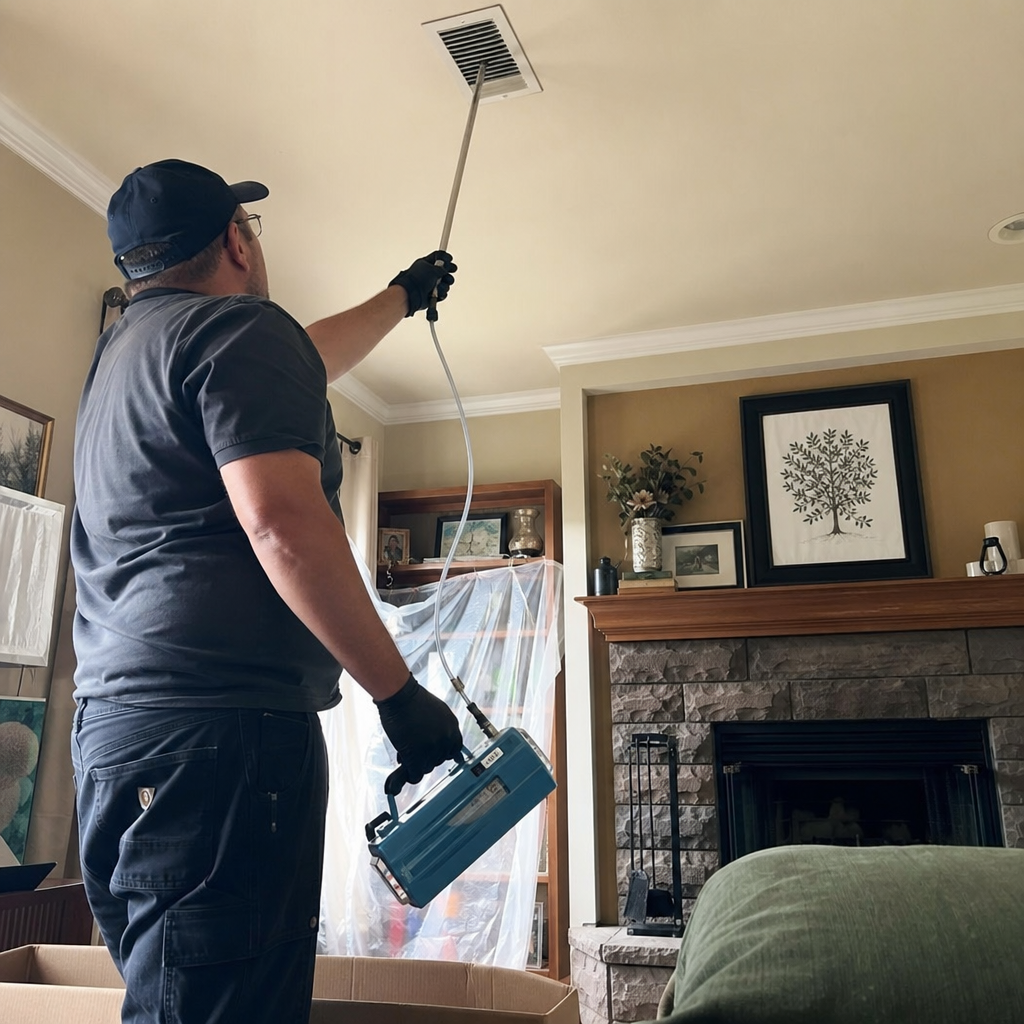
What professional spring cleaning actually involves with our Rotobrush and Nikro systems:
- Negative air setup: The Nikro portable HEPA collector creates suction at the trunk, so dislodged debris exits the home — not your living room.
- Agitation per branch: Rotobrush contact cleaning scrubs duct walls where vacuum-only methods fail. Each supply and return branch gets individual attention.
- Blower and coil cleaning: The HVAC cleaning component — not just ducts, but the components that actually condition air.
- Post-cleaning verification: We inspect access points to confirm debris removal, not just disturbance.
- Condensate in ductwork: Poorly insulated ducts in unconditioned spaces — attics in Rochester’s cape cods, crawl spaces in lake-effect snow country like Webster — sweat when cold supply air meets humid ambient conditions. Standing water in fiberglass-lined ducts becomes a mold amplification site.
- Coil contamination blooming: A dirty evaporator coil in summer is a petri dish. Blower airflow past it distributes microbial fragments through every supply vent.
- Short-cycling and humidity control: Oversized AC units, common in Rochester’s older homes with recent AC additions, cool quickly without dehumidifying. Ducts stay clammy; occupants set thermostats lower, worsening the cycle.
- Supply vent condensation: Visible moisture on metal supply registers signals duct surface temperature below surrounding air dew point. Insulation failure or airflow imbalance.
- Musty odor at startup: Distinct from fall’s burnt dust — this is organic, earthy, and often worse after the system’s been off overnight.
- Drain pan and line function: The secondary pan under the air handler should be dry. Water there means primary drain blockage — a common summer failure.
- Filter loading rate: Summer’s higher particulate from open windows and lawn activity may demand more frequent changes than winter.
- Multiple pets or long-haired breeds
- Occupants with asthma, COPD, or immunocompromise
- Recent renovation (dust from drywall, flooring, etc.)
- Homes with finished basements using original ductwork — common in Rochester’s Park Avenue and East Avenue conversions
- Properties with visible mold history or water intrusion
- Filter condition and fit — remove, hold to light, replace if opaque
- Return grille surface cleaning — vacuum the visible face
- Supply register airflow comparison — all rooms should feel similar; a weak register signals blockage
- Thermostat scheduling — reduce unnecessary cycles
- Outdoor condenser clearance — 2 feet minimum, no vegetation encroachment
- Trunk line and branch duct interior cleaning — Rotobrush contact cleaning or equivalent negative-air system
- Blower wheel removal and cleaning — requires electrical lockout, housing disassembly
- Evaporator coil cleaning — often requires refrigerant line handling, chemical selection knowledge
- Duct leakage testing — pressurization with calibrated fan (we use Nikro duct blaster equipment)
- Duct repair and sealing — mastic application, mechanical fastening, insulation restoration
- Air quality sanitizing — fogging equipment with proper dwell time and ventilation protocol
- Waiting for visible dust at vents: By the time you see it, supply lines are heavily loaded. Vents are the endpoint — contamination starts at returns and blower.
- Using the cheapest filter that fits: In Rochester’s extended heating season, a $3 fiberglass filter costs more in energy and equipment wear than a pleated upgrade. Match to system specs, but don’t default to minimum.
- Ignoring fall startup odors: “It always smells like that” is how homeowners miss gas leaks, cracked heat exchangers, or rodent infestations. Distinguish brief dust odor from persistent chemical or organic smells.
- Closing vents in unused rooms: Rochester’s older duct systems weren’t designed for this. Pressure imbalances strain blowers, increase duct leakage, and can backdraft combustion appliances.
- Scheduling cleaning after major symptoms appear: Emergency calls in January or July peak season mean longer waits and stressed systems. The April–May window exists for a reason.
- Hiring based on coupon price alone: The “$99 whole house” special typically means 45 minutes with a vacuum hose, no trunk access, no component cleaning. Verify what’s included, equipment used, and who’s performing the work.
- Neglecting dryer vent cleaning seasonally: Rochester’s winter laundry loads increase, and lint accumulation is a genuine fire risk. Dryer Vent Cleaning in Rochester should coordinate with duct service.
For Rochester’s older housing stock — the Victorians of South Wedge, the mid-century ranches of Henrietta — spring also reveals whether previous owners’ DIY “improvements” compromised duct design. We’ve found flex duct crushed behind finished basements, original asbestos-wrapped mains with failing seals, and return pathways cobbled from wall cavities without proper filtration.
Spring cleaning demand spikes by late May as allergy sufferers react to opening windows. Book April–early May to avoid the rush and secure the pre-humidity timing advantage.
Summer AC Mode: Humidity, Condensate, and Duct Risks
Rochester summers are shorter than winters, but they’re increasingly humid. July averages 70% relative humidity outdoors — and when your AC runs, the evaporator coil drops air temperature below dew point, creating condensate that must drain properly.
Summer duct risks differ fundamentally from winter:
What to monitor in July and August:
We see the most summer duct damage in lake-adjacent properties — Ontario Beach, Charlotte, parts of Greece — where lake-effect humidity adds 5–10% to already-sticky conditions. If your home’s within a mile of the lake, summer duct insulation inspection is non-negotiable.
Air quality sanitizing with EPA-registered products becomes relevant here — not as a routine, but when summer moisture has created active microbial growth. We apply this through the duct system after mechanical cleaning, using Abatement Technologies fogging equipment that reaches branch lines consumer sprays cannot.
Building Your Two-Year Rochester Cleaning Cycle
The industry default — “every 3–5 years” — assumes average use in average climates. Rochester is neither. Our extended heating season, pollen-heavy springs, and increasingly humid summers compress that interval for most homes.
Here’s the cycle we recommend based on 17 years of Rochester-specific observation:
| Timing | Action | Target Outcome |
|---|---|---|
| October (pre-heating) | Filter change, visual return grille inspection, furnace startup odor assessment | Clean start, early warning identification |
| January | Filter check/replacement, note any odor recurrence or airflow reduction | Mid-season verification, prevent compounding |
| April–May (Year 1) | Professional duct cleaning with HVAC component service | Post-heating deep clean, pre-summer preparation |
| October (Year 2) | Repeat fall inspection; if light use and no red flags, defer professional service | Light-load year assessment |
| April–May (Year 2) | Professional cleaning if deferred; otherwise, inspection and filter cabinet service | 24-month maximum interval maintained |
Homes that should tighten to annual professional service:
The two-year cycle isn’t arbitrary. In our experience, Rochester homes at 24 months show measurable airflow reduction and detectable debris accumulation — not emergency levels, but the point where cleaning delivers clear before/after improvement. Push to 36 months, and you’re managing symptoms rather than preventing them.
What Homeowners Can Check vs. What Requires Professional Equipment
We’re straightforward about this: some maintenance is genuinely homeowner-appropriate. Some isn’t — not because we’re protective of the work, but because the tools and access matter.
Homeowner-appropriate monthly checks:
Requires professional equipment and access:
The dividing line: if you can’t see it and can’t reach it with a household vacuum attachment, you’re not cleaning it — you’re disturbing surface debris that will redeposit. We’ve been called after homeowners rented “duct cleaning” machines from hardware stores and found the main trunk still loaded, with only the first 6 feet of each branch addressed.
Matthew shows up on every job with the full Rotobrush and Nikro setup — not a shop vac with a long hose. The difference is measurable in airflow recovery and debris removal.
Common Mistakes to Avoid
When to Call a Professional
Call when: startup odors persist beyond 48 hours; you notice uneven heating or cooling room-to-room; filters load visibly faster than seasonal norms; any family member experiences unexplained respiratory symptom seasonality; you’ve completed renovation work; or you’re approaching 24 months since last professional service.
We’re not going to invent urgency where none exists. But we’re also not going to let Rochester homeowners assume that “everyone’s ducts are dirty” means yours don’t matter. Airflow matters. System longevity matters. And for households with asthma, allergies, or infants, the particle load in circulated air genuinely affects daily life.
Elite Air Duct Cleaning Service Greater Rochester home offers free estimates in Rochester — call (844) 593-2704. Matthew Gonzalez personally evaluates every job, explains what the inspection reveals, and quotes only what’s needed. No franchise upsell scripts, no rotating subcontractors. See what 571 homeowners experienced at 4.9 stars.
Frequently Asked Questions
Every 18–24 months for most Rochester homes, with annual service for households with pets, allergy sufferers, or recent renovations. Rochester’s extended heating season and humid summers compress the effective interval compared to milder climates. Call (844) 593-2704 for a free estimate on timing for your specific home.
Brief burnt-dust odor is normal — dust accumulated on heat exchangers during idle months burns off. If it persists beyond a day or recurs throughout winter, you’re likely smelling accumulated debris being reheated, which signals duct contamination worth inspecting. Persistent chemical or rotten-egg odors require immediate professional evaluation for gas or combustion safety.
Yes — late April through mid-May captures the full winter debris load before summer humidity enables microbial growth, and beats the late-May rush when allergy sufferers react to open windows. Spring also allows inspection for winter damage before cooling season demand peaks.
Yes — debris-loaded blower wheels and restricted ductwork force your system to run longer to achieve the same temperature. In Rochester’s heating-dominant climate, that penalty compounds across a 6–7 month season. We’ve measured airflow recovery of 15–30% post-cleaning in heavily loaded systems.
Duct cleaning addresses the distribution network — supply and return trunk lines, branches, and registers. HVAC Cleaning in Rochester includes the air handler components: blower wheel, evaporator coil, heat exchanger, and drain pan. We recommend both together for complete system restoration, not ducts alone.
Verify: they name their equipment brands (we use Rotobrush and Nikro systems); the owner or lead technician performs work (Matthew Gonzalez is on every job); they have substantial verified reviews (571 at 4.9 stars); and they explain what’s included beyond a vacuum pass — blower cleaning, coil access, post-verification. Avoid anyone who won’t specify or who prices by vent count alone.
The Bottom Line
Rochester’s climate demands a seasonal approach to duct care, not a calendar-date reminder. Fall startup reveals winter’s incoming load. Winter’s extended heating compounds it. Spring’s pre-humidity window offers the year’s best cleaning opportunity. Summer’s humidity creates distinct risks requiring different vigilance. Build your maintenance around these actual triggers — inspect seasonally, filter strategically, and schedule professional cleaning every 18–24 months with a technician who explains what they find. For more guides & resources on protecting your system year-round, explore our blog. Your system’s efficiency, your home’s air quality, and your family’s respiratory comfort all benefit from timing that matches Rochester’s reality, not an industry average from somewhere warmer.
Ready to schedule your spring inspection or build a seasonal maintenance plan? Call Elite Air Duct Cleaning Service Greater Rochester at (844) 593-2704 for a free estimate. Matthew Gonzalez will evaluate your system personally, explain what the inspection reveals, and recommend only what’s needed — no more, no less.
Written by Matthew Gonzalez, Owner & Lead Technician at Elite Air Duct Cleaning Service Greater Rochester, serving Rochester since 2009.